Events: In the clay target world, common events are singles, doubles and handicap trap, along with skeet, sporting clays and five stand. An explanation of events is farther down the page.
Equipment needed: Competitors need a shotgun. While many types of shotguns will work, people with a love for the sport usually choose adjustable purpose-built trap shooting guns. Competition gun prices can ranges from $1400 to five-digit price tags. Don’t sweat it though, most field guns work fine as well and lots of great scores are shot with a well-used pump gun. Any shotgun with an exposed hammer is not usable because of safety concerns. Competitors will also need a pouch or specifically designed vest to hold shells, eye protection and ear protection. Prescription glasses work as eye protection. A pad to rest the shotgun on between turns is recommended as well. It reduces shooter fatigue.
Shooting glasses: Standard safety glasses will protect your eyes, but glasses with amber or orange lenses can help with target acquisition by filtering out blue light. Like in every sport, more money can mean better equipment. If you wear prescription eye glasses, they work as safety glasses as well. It is possible to buy shooting glasses with your prescription ground into them.
Length of Pull: Distance from the trigger to the butt of the shotgun. Often abbreviated as LOP. Logically, taller shooters often need a longer LOP.
Choke: The taper of the end of the shotgun barrel that helps shape the pattern of the shot. Some guns have interchangeable chokes, on others the choke is formed into the barrel. A full choke will keep the smallest pattern of shot at a distance, improved modified (IM) is slightly wider. Those are the preferred chokes for trap.
Over Under Shotgun: A shotgun with two barrels stacked on top of each other. Can be used for singles, doubles, skeet or sporting clays. Each barrel can have a different choke. Very common among competition shotguns.
Combo gun: A shotgun package that comes with both a single barrel, for singles trap and handicap trap and an over under barrel set.
Comb: Portion of the shotgun stock that the cheek is rested on. On competition shotguns, the comb is adjustable up and down and left and right. The goal is to adjust the comb up and down to give the shooter a clear view of the target when shooting. Left and right adjustments help get the shooters eye centered over the rib.
Rib: Flat sight on the top of a shotgun barrel. Competition guns may have an adjustable rib.
Point of Impact: Where the center of the shot cloud hits the target. Sometimes abbreviated as POI.
12 gauge v. 20 gauge: Although it initially feels counterintuitive, a 12 gauge shotgun is often easier on the shooter than a 20 gauge. Many small stature shooters and parents mistakenly choose 20 gauge shotguns because of their light weight. If the competitor can comfortably hold the weight of the 12 gauge it’s a much better option. The added weight of the gun eases recoil and the additional shot headed toward the target is helpful too.
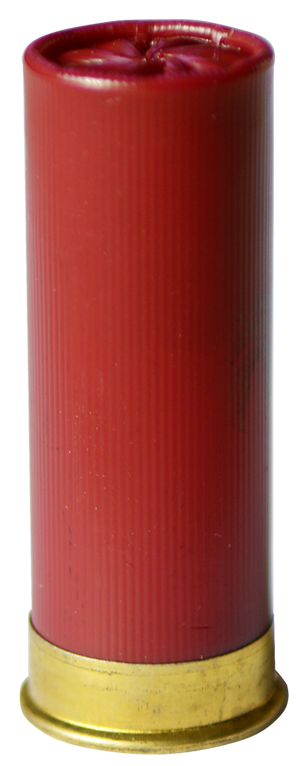
Ammunition: For standard trap shooting, more powerful ammunition does not give an advantage, it can do the opposite. Number 8 shot, 1 1/8 oz. 1145 fps or 1 oz. 1200 fps works well. It’s a great load that doesn’t have strong recoil allowing competitors to shoot throughout a day without bruising or pain. Competing in handicap trap events may require slightly more powerful ammunition because of the increased distance from trap house.
What makes a competition trap gun different from a field gun?
Competition guns usually have several features that field guns don’t. Among those differences are more weight, adjustability for point of impact. Some may feature recoil reduction systems as well.
Weight: a light weight field gun is great, you might shoot a box of shells through it on a good day of hunting. During some trap shoots, a competitor could shoot a few hundred shells in a day. The added weight of a trap gun reduces felt recoil.
Adjustability: Having a shotgun that can be adjusted to fit the shooter improves comfort, consistency and scores.
Types of clay target competition
There are many different clay target competitions. This will be focused on the most common shot in most US gun clubs.

American Trap
The graphic shows this sport which is also known as “singles”. It is probably the most basic of the clay targets sports, but by no means easy. Five competitors stand side-by-side at different posts 16 yards from the trap machine. The posts are known as Post 1 through Post 5. The shooter mounts their gun before the target is thrown. When each competitor calls “Pull” a single clay target is thrown. The shooter gets one shot at the target. The target thrower oscillates in its house making the angle of each target unpredictable for the shooter. If the target is hit, the scorekeeper marks it, if it is missed they will call “loss”. After five shots, the shooters file to their right with the person at the far right (Post 5) moving to the far left (Post 1). After the shooters have each shot at 25 targets, the round is over. In competitive events, like Amateur Trapshooting Association (ATA) events, shooters are divided into classes based on skill.
American Doubles Trap
Very similar to American Trap, but two targets are thrown at a time and the machine is in a fixed position, no oscillation. Each competitor shoots at 25 pairs of targets per round. Just like American Trap, at ATA events, shooters are put into classes based on their skill.
Handicap Trap
Very similar to American Trap, but shooters are arranged at different distances based on their shooting skills. Entry level handicap shooters begin at the 19 yard-line, as their skill and scores increase, they may be required to shoot at longer distances. The best shooters will compete from the 27 yard-line. The machine oscillates just like American Trap. Shooters standing near one another must be at similar yardages because of safety concerns, a 19 yard shooter will not compete in the same round as a 27 yard shooter. The idea behind this event is that all shooters should be equal because of the difference in distance from the target.
Sporting Clays
Sporting Clays is meant to mimic hunting scenarios. Competitors walk or drive from station to station, a course often consists of 10-15 stations. One to several targets can be thrown at a station, sometimes shooters shoot from a blind or an elevated platform. The targets often vary in size with some being airborne and others rolling across the ground to mimics rabbits. Targets can come one at a time, or in different variations of two at a time.
Five Stand
Similar to Sporting Clays in many ways, but without the course. Shooters will shoot several targets, often five, at each of five stations. Their will usually be a single target and a couple pairs of targets coming from a variety of throwers creating many different scenarios.
Skeet
Many folks use the term skeet to describe any clay target shooting, when it is a single event. Competitors shoot from eight different stations arranged in a semi circle. Targets come from two different target throwers, one high off the ground and one low to the ground. Because of the semi circle arrangement of the posts, at some points the competitor is standing almost next to the area where the target exits the thrower giving the targets the feeling of flying very quickly. 24 targets are thrown with an optional single additional target that is thrown when a target is missed.
Shooters, parents, coaches and teams track stats – check out deadbirdstats.com, it’s a big help for new and seasoned shooters. It can help identify trends in shooting and also creates a “shooting resumé” for trap shooters.